IMPR-RAD-01
A mesh radio node that keeps a team on one ATAK picture where there is no tower, server or internet. Two revisions, both field tested.
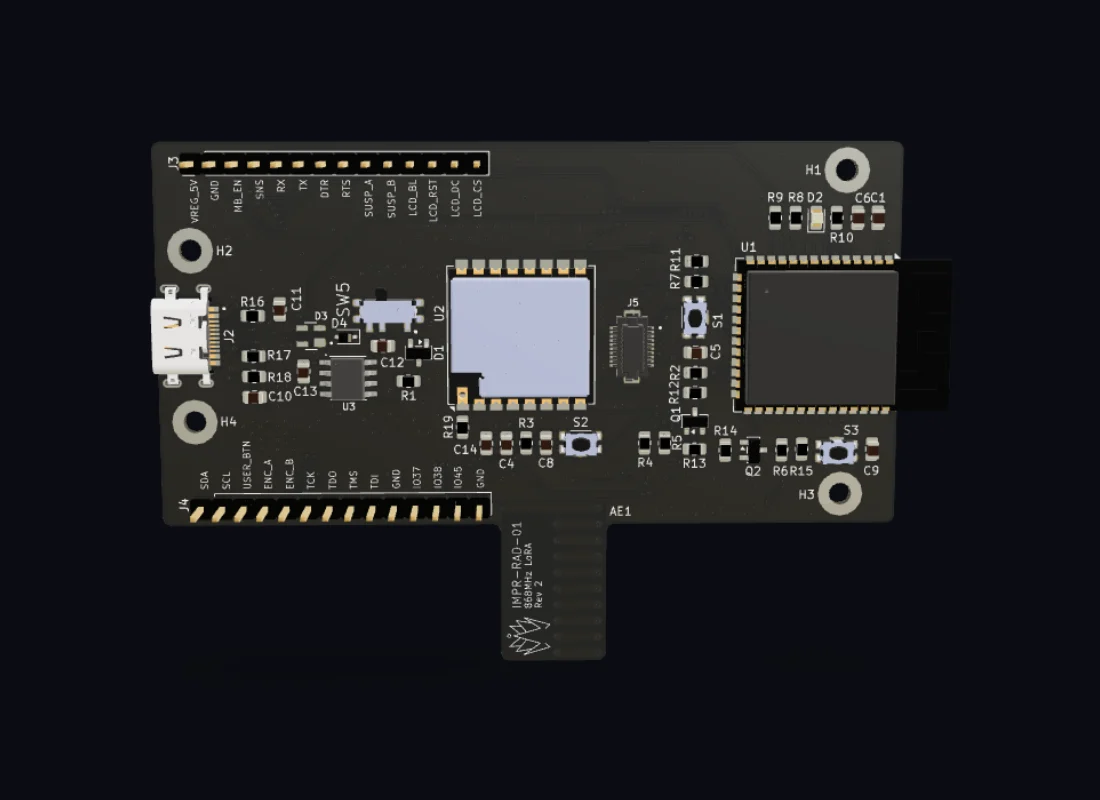
One node, built to expand
Rev2 keeps the field-tested ESP32-S3 core and adds three expansion ports, a 1 A power rail with headroom for the modules on them, and a current-generation SX1262 LoRa radio.
Designed and built in-house: hardware, mesh firmware, ATAK integration and telemetry.
One mesh, every mission.
Earthquake response, wildfires and tactical teams working in ATAK.
Radio, core and expansion on one board
- 01 An ESP32-S3 runs the mesh firmware across LoRa, Bluetooth LE, ESP-NOW and Wi-Fi.
- 02 An SX1262 LoRa radio, with an on-board PCB antenna or a U.FL connector for an external one, set at assembly.
- 03 A 1 A 3.3 V rail with bulk reserve for transmit bursts and the modules stacked on the node.
- 04 Three 20-pin expansion ports: one on top, two underneath.
Specifications
Radio & power
- Transceiver
- SX1262 LoRa
- Band
- 868 MHz
- Antenna
- On-board PCB or U.FL external
- 3.3 V rail
- 1 A, with burst reserve
- Power input
- USB-C or IMPR-POW-R-01
Core
- MCU
- ESP32-S3 · 8 MB flash · 8 MB PSRAM
- Links
- LoRa · BLE · ESP-NOW · Wi-Fi
- Clock
- 32.768 kHz crystal
- Debug
- USB · JTAG
- Buttons
- Reset · boot · user
Mechanics & expansion
- Outline
- ≈ 88 × 63 mm
- Stack-up
- 4-layer PCB
- Assembly
- Two-sided
- Expansion
- 3 × 20-pin DF12 · 1 top, 2 bottom
- Mounting
- M2.5, shared across the stack
Two revisions. Both field tested.
Rev1 is a complete, field-tested node. Rev2 keeps the same core and adds room to grow: expansion ports, a larger power budget for the modules on them, and a newer LoRa radio chosen for its lifecycle.
Built to expand.
Rev2’s three ports turn the node into a platform: add a screen on top or extend it underneath, without replacing the radio.
IMPR-DISP-01
Display and controls: a status screen, four buttons, an 80 dB buzzer and status LEDs.
View IMPR-DISP-01RAD-01 Extension
Extends the node underneath. Planned: GNSS positioning, storage and a real-time clock.
Register InterestYour custom module
Need a sensor, power or I/O module for your program? We design custom modules to the same connectors, so they stack on a fielded node.
Discuss a Custom ModuleATAK over the mesh.
Works with ATAK-CIV 5.5+This is how we run RAD-01: each operator’s phone pairs with a node, and the team keeps working in ATAK as usual. The mesh carries the shared picture where there is no tower, server or internet.
Phone to node over Bluetooth LE or Wi-Fi; node to node over LoRa.
- Positions
- Markers
- Drawings
- Routes
- Chat
- Images
- Voice
- Video
-
One picture for the whole team
Positions, markers, drawings and routes reach every node on the mesh, so everyone works from the same map.
-
Chat built for gaps
Messages for someone out of reach wait in the mesh and go through when they come back in range.
-
Several phones per node
Phones connect over Bluetooth LE or Wi-Fi, so one node can serve several operators.
-
Nothing new to learn
The mesh works underneath ATAK. Operators keep the map, chat and markers they already use.
Images, voice and video need more bandwidth than LoRa gives. They move to the HaLow link of IMPR-VOX, now in field test.
Discuss a Mesh DeploymentA software-defined radio with 2×2 MIMO.
A modular Linux and FPGA radio core that will carry the same TAK traffic over Wi-Fi, Bluetooth LE, LoRa and HaLow, with a replaceable 2×2 SDR card for a higher-throughput mobile mesh. It runs our existing VOX and DISP-01 modules.
Ask About PRIMARCH- SDR card
- 2×2 coherent: two transmit and receive chains
- Tuning range
- 325 MHz – 3.8 GHz
- Bands
- 868/915 MHz, L band and part of S band
- Channel width
- Up to 20 MHz
- MIMO roadmap
- Diversity (STBC) first, then spatial multiplexing
- Upgrades
- Swappable radio cards for other bands
In design: performance figures will be published only once measured.
Need a mesh node like this for your program?
Ask about RAD-01 and its modules, or have the team that built them design yours. Mutual NDA first; a full proposal with budget and timeline before any work starts.